
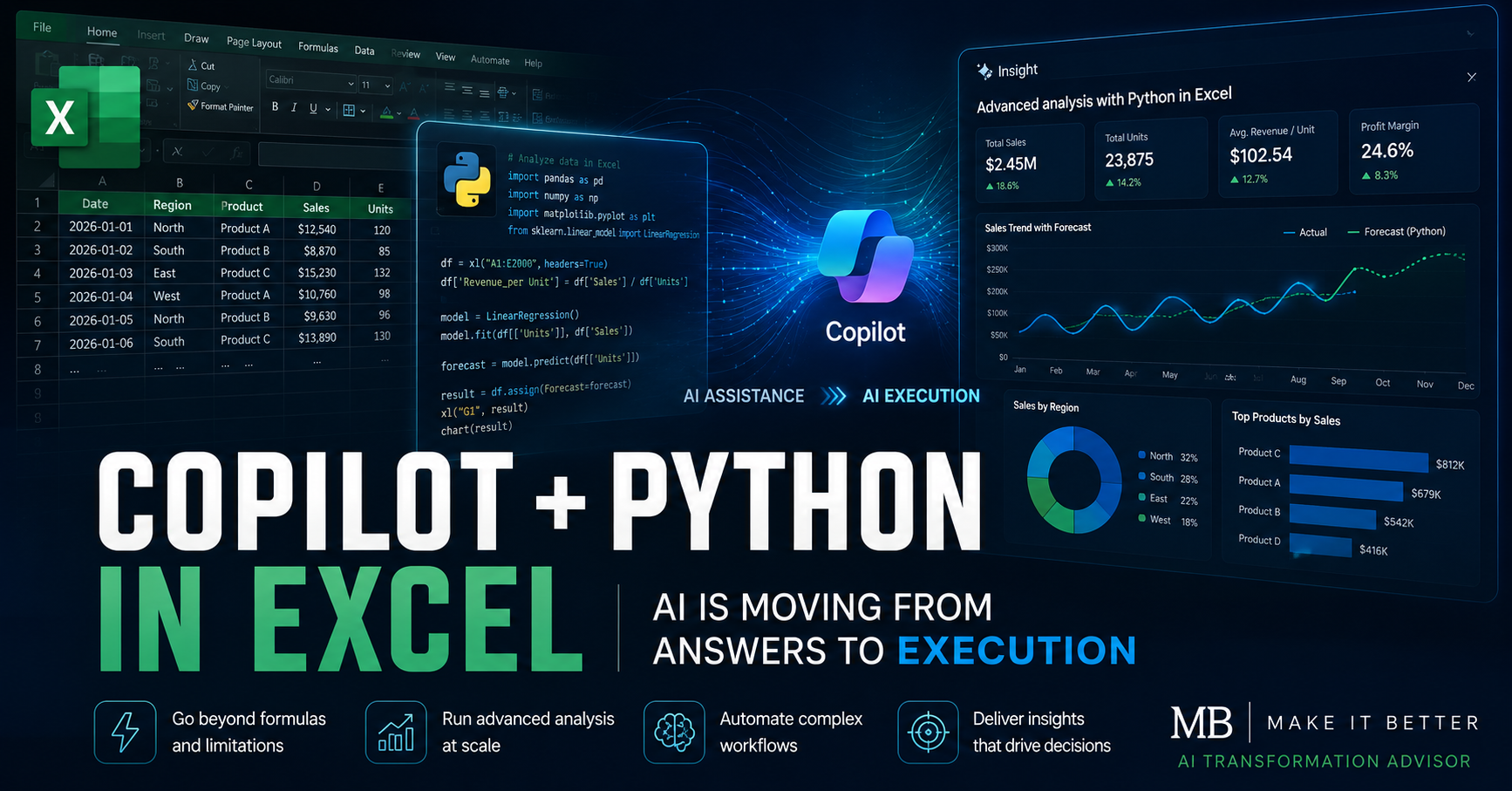
The most important Excel announcement this week is not that Copilot can use Python.
It is that AI is moving another step from giving us answers to executing work inside the tools we already use.
Microsoft's latest Copilot update brings Python directly into the Edit with Copilot experience in Excel. Users can now describe what they want in natural language and let Copilot use Python for advanced analysis, statistics, simulations, visualizations, automation and data transformation.
That may sound like an Excel feature.
I think it signals something much bigger.
Copilot is moving from assistant to execution layer
For the first wave of Generative AI, most business users learned a simple interaction:
Ask a question.
Receive an answer.
Copy the answer somewhere else.
That was already valuable.
But the next phase looks very different.
The AI does not simply tell you how to perform an analysis. It can increasingly perform that analysis inside the application where your work already lives.
In Excel, that means Copilot can understand the request, plan the work, use Excel capabilities and now use Python when deeper analysis is required.
Think about the difference.
Instead of asking:
“How do I calculate which customers are becoming less profitable?”
and then building formulas yourself, you can ask Copilot to analyze customer profitability, identify unusual patterns, explain what changed and create the supporting analysis directly in the workbook.
The interface becomes natural language.
The execution engine underneath can become much more sophisticated.
Why Python changes what business users can ask
Python has been one of the world's most important languages for analytics, automation and data science for years.
The problem for most business users was never whether Python was powerful.
The problem was accessibility.
A finance manager may understand margins perfectly but not know Python.
An operations manager may understand inventory risk but not know how to build a statistical model.
A sales director may immediately recognize abnormal customer behavior but not know how to program the analysis.
Copilot changes that interface.
The employee can describe the business problem.
AI can translate the intent into analysis.
Python can provide the computational capability.
Excel remains the environment the employee already understands.
That combination is powerful.
Imagine these questions coming from normal business users
A CFO could ask:
“Analyze the last 24 months of operating expenses, identify unusual movements, separate seasonal patterns from anomalies, and show me the five areas management should investigate first.”
A sales manager could ask:
“Analyze customer revenue, margin and order frequency. Identify customers whose purchasing behavior suggests that we may be losing them.”
A supply-chain manager could ask:
“Compare inventory movements, sales velocity and lead times and identify items most likely to create a stockout during the next six weeks.”
A CEO could ask:
“Analyze revenue growth, margin development and operating expenses by business unit and show me where growth is increasing complexity without increasing profitability.”
Not every result will automatically be correct.
But notice what changed.
These are no longer primarily Excel questions.
They are business questions.
And that is exactly why this announcement matters beyond Excel.
The real shift: business applications are becoming executable through language
For years, enterprise software required users to adapt themselves to the system.
- Learn the menu.
- Learn the report.
- Learn the formula.
- Learn the query.
- Learn which button performs which action.
Generative AI is gradually reversing that relationship.
The user describes the outcome.
The system determines how to execute more of the work.
We can already see this direction across Microsoft 365, Copilot, Power Platform, Dynamics 365 and AI agents.
Excel using Python through Copilot is another important step.
The long-term transformation is not:
“Everyone becomes a Python programmer.”
It is:
“More employees gain access to capabilities that previously required specialized technical skills.”
That can dramatically change productivity.
But it also creates a new management challenge.
When AI starts executing, governance becomes more important
When AI only generates text, an incorrect answer is a problem.
When AI performs analysis, changes a workbook, triggers a workflow or eventually acts across business systems, an incorrect action can become a much bigger problem.
This is where many AI strategies are still immature.
Organizations are asking:
Which AI tool should we buy?
They should increasingly also ask:
- What data can the AI access?
- What actions can it perform?
- Which actions require human approval?
- How do employees verify an AI-generated analysis?
- Who owns the decision made from the result?
- How is the action audited?
- What happens when the model, data source or cloud service is unavailable?
The better AI becomes at execution, the more important these questions become.
Excel is a perfect place to see this transition
Excel sits in the middle of an enormous amount of business decision-making.
Even companies with sophisticated ERP environments often have important decisions being prepared or validated in Excel.
That means AI capabilities inside Excel can create immediate business value.
But they can also magnify existing weaknesses.
If the source data is wrong, AI can analyze the wrong data faster.
If the workbook contains outdated assumptions, automation can scale outdated assumptions.
If nobody verifies the result, a beautifully produced analysis can still drive a bad decision.
The question should therefore never be:
“Can Copilot do this?”
The better question is:
“Can we use Copilot to do this faster while keeping the result controlled, explainable and accountable?”
What business leaders should do now
You do not need a large AI transformation programme to start learning from this shift.
Start with three practical steps.
1. Find analyses people repeatedly perform manually
Ask finance, operations, sales and management:
Which analysis do you rebuild every week or every month?
These are often excellent Copilot candidates.
2. Separate assistance from execution
Document what AI may:
- suggest,
- analyze,
- create,
- modify,
- or execute.
Then define where human approval remains mandatory.
3. Measure business value, not AI activity
Do not measure adoption only through prompts or licenses.
Measure:
- time saved,
- decisions accelerated,
- errors reduced,
- manual steps eliminated,
- risks detected earlier,
- and business outcomes improved.
That tells you whether AI is actually transforming work.
One more reason executives should pay attention
The Copilot + Python announcement is easy to classify as another Microsoft feature release.
I would not.
The important signal is that increasingly sophisticated execution capabilities are becoming accessible through normal business language and are appearing inside applications employees already use every day.
That is how AI adoption can accelerate very quickly.
Not because every employee suddenly becomes an AI expert.
Because AI becomes part of how ordinary work gets done.
The companies that prepare for that transition now will have an advantage.
Not simply because they bought Copilot first.
Because they understood how to connect AI capability, trusted data, business processes, governance and human accountability before execution became widespread.
Is your organization ready for AI that can execute?
I recently turned this question into a practical 10-question Executive AI + ERP + BI Readiness & Resilience Diagnostic .
It looks at whether management has enough control, visibility and readiness across AI, ERP and BI to safely move from experimentation toward business execution.
If you are based in Lebanon and evaluating how Microsoft Copilot, Generative AI and AI agents can improve your organization, explore my Generative AI and Microsoft Copilot training and consulting in Lebanon .
The next AI advantage will not come from asking better questions alone. It will come from knowing which work AI should execute, which decisions humans must keep, and how the two operate together.
Related Posts