
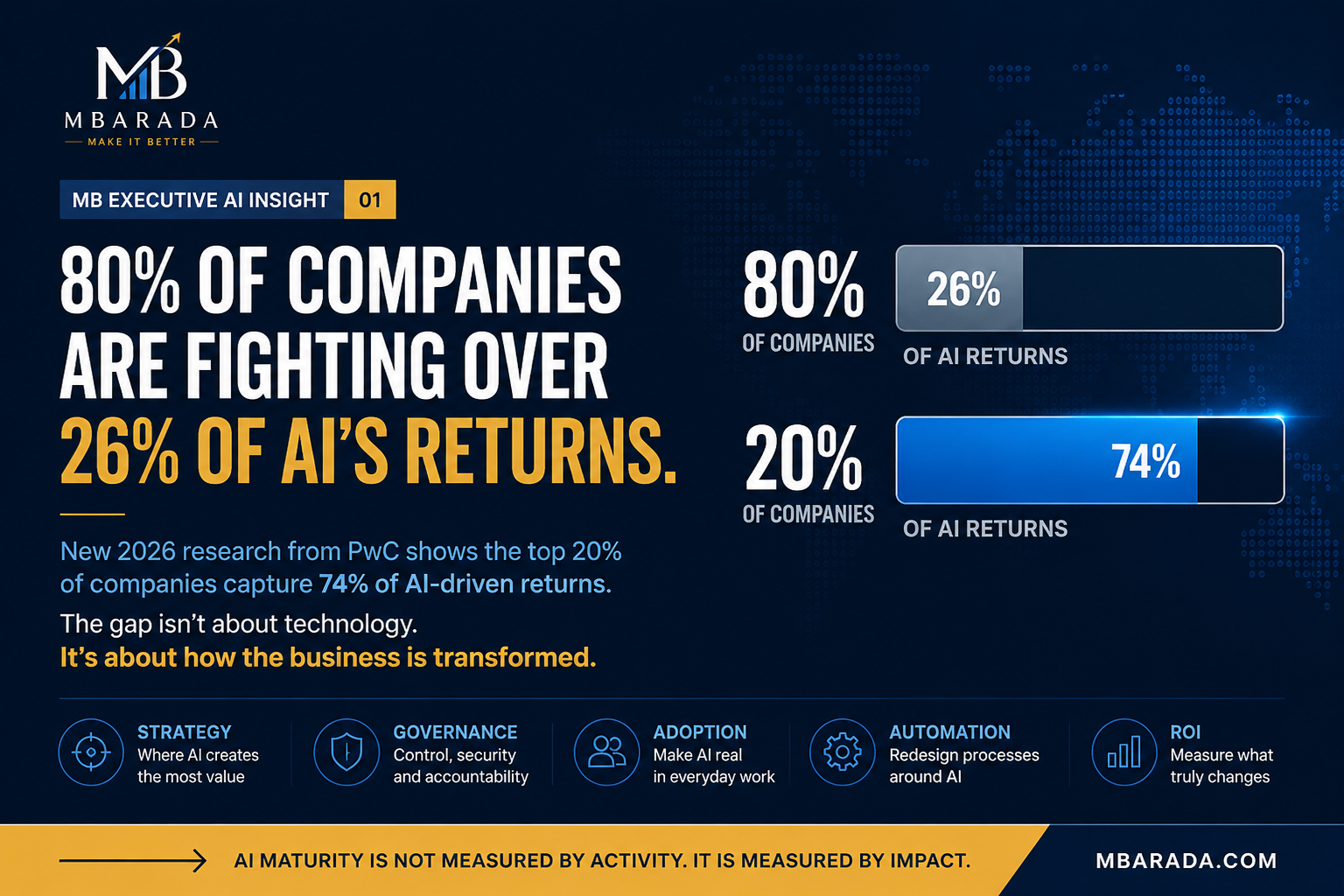
80% of Companies Are Fighting Over 26% of AI's Returns.
The AI performance gap is becoming enormous. Better models are not the main reason.
Here is an uncomfortable AI statistic for every CEO.
PwC studied 1,217 organizations across 25 sectors and found that the top 20% of companies are capturing 74% of AI-driven returns.
Put differently:
The surprising part is not that some companies are ahead.
The important question is:
Why are they ahead?
The answer appears to be much less about having access to better AI models and much more about what organizations do around the technology.
The Market Is Confusing AI Activity With AI Value.
Look inside many organizations today and you will find plenty of AI activity.
- Employees using ChatGPT
- Microsoft Copilot licenses being deployed
- Departments experimenting with AI agents
- Prompt libraries being created
- AI training programs running
- Proofs of concept appearing everywhere
All of this can be useful.
But none of it, by itself, proves that AI has created measurable business value.
AI maturity is not measured by how much AI a company uses. It is measured by how much the business changes because AI exists.— Mohamad Barada
This distinction is becoming increasingly important.
An organization can have hundreds of Copilot users, dozens of AI experiments and multiple agents — yet still struggle to explain to the CFO what actually changed.
Company A vs. Company B
AI as Activity
Buys Copilot licenses
Runs AI training
Launches several pilots
Builds a few agents
Measures usage
AI as Transformation
Chooses a business outcome
Finds the process creating friction
Establishes the baseline
Redesigns the workflow around AI
Measures the business outcome
AI Leaders Are Redesigning Work — Not Just Adding AI to It.
One of the most revealing findings in PwC's research is that AI leaders are about twice as likely to redesign workflows around AI rather than simply add AI tools to existing processes.
That sounds subtle.
It is not.
Add AI to the Existing Process
Redesign the Process Around AI
Consider a finance team spending hours preparing management commentary every month.
A superficial AI project might ask:
A transformation approach asks:
The technology may ultimately be the same.
The business result can be completely different.
Five Questions Before Another AI Investment.
STRATEGY
Where should AI create value?Identify business priorities, expensive friction and high-value opportunities.
GOVERNANCE
What is AI allowed to do?Define ownership, access, authority, human approval and accountability.
ADOPTION
How does AI become real work?Create role-specific scenarios, capability and repeatable practices.
AUTOMATION
What should happen differently?Redesign workflows around AI, agents, ERP, data and human judgment.
ROI
What changed?Measure speed, productivity, quality, cost, revenue and decisions.
The Most Important AI Dashboard May Not Contain AI Metrics.
If I were reviewing an AI initiative with a leadership team, I would be less interested in:
- number of prompts
- number of Copilot activations
- number of AI agents created
- number of employees trained
Those metrics can help explain adoption.
They are not the final outcome.
I would want to see:
The real AI KPI is not how often people use AI. It is whether valuable work happens differently.— Mohamad Barada
This Matters Even More in Markets Where the Opportunity Is Large but Resources Are Not Unlimited.
For organizations across the GCC and Africa, AI presents an extraordinary opportunity.
But the answer cannot simply be to replicate every global AI trend.
Organizations have different levels of ERP maturity, data quality, infrastructure, regulation, skills, operating cost and management readiness.
That makes prioritization even more important.
PwC's 2026 Africa analysis points to a similar opportunity: employees in the region show strong openness to AI, but organizations are not yet consistently converting that readiness into enterprise-wide value.
Before Approving Your Next AI Project, Ask These 7 Questions.
What specific business outcome are we trying to change?
What is the current baseline?
Why is AI the right intervention?
Which process needs to change around the AI?
What data, ERP, BI or operational systems does it depend on?
Where does human judgment or approval remain mandatory?
What metric will prove that this was worth doing?
The Next AI Advantage Will Not Come From Having Access to AI.
Access is rapidly becoming universal.
Models improve. Prices fall. AI enters every productivity platform and enterprise application.
That means access itself becomes less differentiated.
The advantage moves somewhere else:
The companies learning to do those things now are likely to keep taking a disproportionate share of AI's returns.
The question is not whether your organization is using AI.
Is AI changing the business?
Where Could AI Create Measurable Value in Your Business?
Start with one department, one process and one measurable objective. Identify the opportunity, assess the systems and data behind it, prove the value and scale what works.
PwC 2026 AI Performance Study, based on 1,217 organizations across 25 sectors, and PwC's 2026 analysis of AI ROI in Africa.
This article provides independent interpretation and advisory commentary by Mohamad Barada. Statistics belong to their respective research sources.
Related Posts